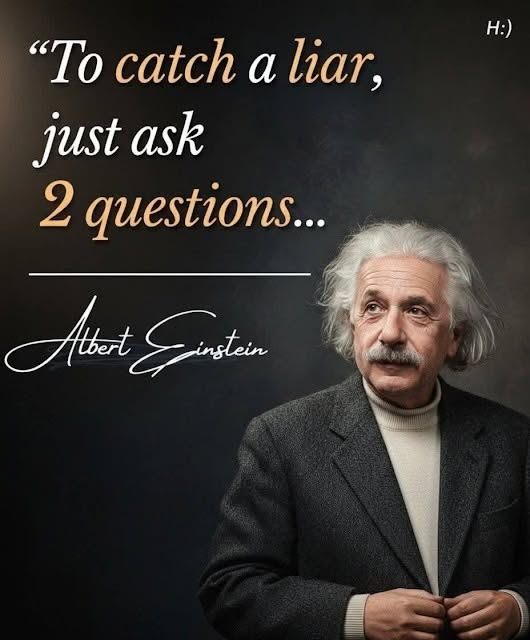
The statement “To catch a liar, just ask 2 questions” is popular on social media, but it exaggerates what these questions can do. There are no two questions that reliably expose every liar. However, some interview techniques are designed to make deception more difficult and to reveal inconsistencies. They are best thought of as ways to gather information—not as lie detectors.
The two commonly suggested questions
Question 1:
“Can you tell me exactly what happened, from the beginning to the end, including as many details as you can remember?”
Why this question is useful
When people describe a real event, they’re usually recalling an actual memory. They often mention:
- The sequence of events.
- People who were present.
- Sights, sounds, or conversations.
- Small details they weren’t trying to memorize.
Someone inventing a story may:
- Keep it vague.
- Avoid unnecessary details.
- Add details that later conflict with other parts of the story.
Example
Suppose someone says they were at a coffee shop from 2:00 to 3:00 p.m.
You ask:
“Walk me through everything you did from the moment you arrived until you left.”
A truthful response might include:
- Arrived at 2:05.
- Ordered a cappuccino.
- Waited about five minutes.
- Sat near the window.
- Answered emails.
- Saw a friend briefly.
- Left around 3:00.
A fabricated story might be much shorter:
“I got coffee, sat there, and left.”
That doesn’t prove lying, but it provides fewer details to verify.
Question 2:
“Now tell me the same story again, but this time in reverse order, starting from the end and working backward.”
Why this question is used
Recalling a real memory backward is mentally demanding, but the memory already exists.
Inventing a fake story in reverse is often harder because the person has to:
- Keep the fabricated timeline consistent.
- Avoid contradictions.
- Remember what they previously claimed.
This extra mental effort can sometimes reveal inconsistencies.
Example
Forward:
“I entered the building, met Sarah, went upstairs, attended the meeting, and then left.”
Backward:
“I left the meeting, walked downstairs, said goodbye to Sarah… wait… actually I met her outside… no, inside…”
Those inconsistencies might prompt further questions—but they still don’t prove deception.
Why these questions sometimes work
Researchers studying deception have found that lying generally requires more mental effort than recalling a genuine memory. A liar must often:
- Invent information.
- Remember previous lies.
- Keep the story internally consistent.
- Predict what the interviewer already knows.
Questions that increase cognitive load can make inconsistencies more likely to appear.
What professionals actually do
Investigators, journalists, auditors, and interviewers usually don’t rely on just two questions. They may:
- Ask the same topic in different ways at different times.
- Request specific details about places, times, and people.
- Compare statements with independent evidence.
- Look for consistency across multiple interviews.
The goal is to evaluate the overall reliability of the account, not to catch someone with a trick.
Important limitations
Even truthful people may:
- Forget details.
- Get nervous.
- Confuse the order of events.
- Make honest mistakes.
Similarly, someone who is lying may:
- Stay calm.
- Tell a well-rehearsed story.
- Remain consistent.
Because of this, no pair of questions can reliably determine whether someone is lying.
Summary
The two questions most often associated with this idea are:
- “Tell me everything that happened from beginning to end, including as much detail as you can remember.”
- “Now tell me the exact same story again, but in reverse order, from the end back to the beginning.”
These questions can sometimes make deception more difficult by testing the consistency and richness of a person’s account. However, they are not lie detectors. The strongest way to assess whether someone is truthful is to compare what they say with objective evidence and look for consistency over time, rather than relying on any single questioning technique.