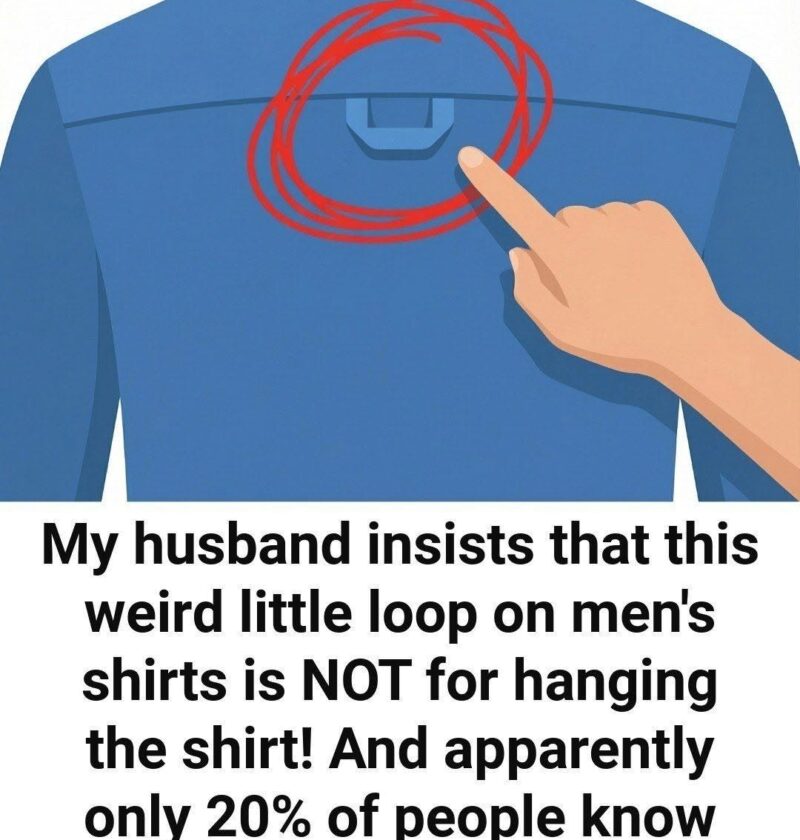
The small loop you sometimes see on the back of button-down shirts, especially near the upper yoke, has an interesting history and a few practical explanations. It’s often called a “locker loop” or “shirt loop.” While today it’s mostly decorative, it originally had very practical purposes.
Why Button-Down Shirts Have Loops on the Back
1. The Original Purpose: Hanging Shirts in Tight Spaces
The most widely accepted reason is very practical.
What it was for:
The loop allowed men to hang shirts on hooks instead of hangers.
Where this mattered:
- College dorm rooms
- Military barracks
- Locker rooms
- Small closets or travel situations
Instead of folding or hanging with a bulky hanger, you could simply:
👉 Hook the shirt by the loop
👉 Keep it from getting wrinkled or crushed
That’s why it’s still called a “locker loop.”
2. Ivy League Fashion Tradition (1960s Popularity)
The loop became especially popular in the mid-20th century when it was adopted by American Ivy League students.
Brands like Gant played a major role in popularizing this style.
Meaning in that culture:
- It signaled a “preppy” or elite college look
- Sometimes students would even remove the loop if they were “taken” in relationships (similar to jewelry traditions like class rings or friendship symbols)
So beyond function, it became a fashion and identity marker.
3. Navy and Military Influence
Some versions of the loop design are linked to naval clothing traditions.
In military contexts:
- Clothing needed to be stored efficiently
- Hooks were easier than folding in cramped quarters
- Uniforms often included hanging loops for practicality
This influenced civilian fashion later on.
4. Modern Use: Mostly Decorative Today
In most modern shirts, the loop is:
- Not strongly reinforced
- Not intended for regular hanging use
- Added mainly for heritage and style
Many people don’t even use it anymore because:
- Closets are more common
- Hangers are standard
- Wrinkle-resistant fabrics are widely available
5. Variations You Might See
Shirt loops can differ depending on brand and style:
- Single loop (most common)
- Double loop (rare, more decorative)
- Fabric-matched loop or contrast loop
- Sometimes replaced with a small fabric tab instead
6. Why It Still Exists Today
Even though it’s mostly unnecessary now, brands keep it because:
- It signals “classic American shirt heritage”
- It adds visual detail to the back of the shirt
- Consumers associate it with quality or traditional styling
- Fashion often keeps old features for identity and nostalgia
Brands like Brooks Brothers still use heritage design elements like this in many shirts.
Common Myths
❌ “It’s for hanging shirts after ironing only”
Not specifically—its original purpose was general hanging convenience, not ironing.
❌ “It shows marital status”
This is a popular myth, but there is no historical evidence that loops indicated relationship status.
❌ “It has a strict military code meaning”
Military influence existed, but no formal rule about loops has been documented.
Key Takeaway
The loop on the back of button-down shirts—called a locker loop—was originally designed for hanging shirts in small spaces without hangers, especially in dorms, lockers, and military settings. Over time, it became a fashion tradition, especially through Ivy League style, and today it is mostly a decorative feature that reflects classic shirt heritage rather than a necessity.