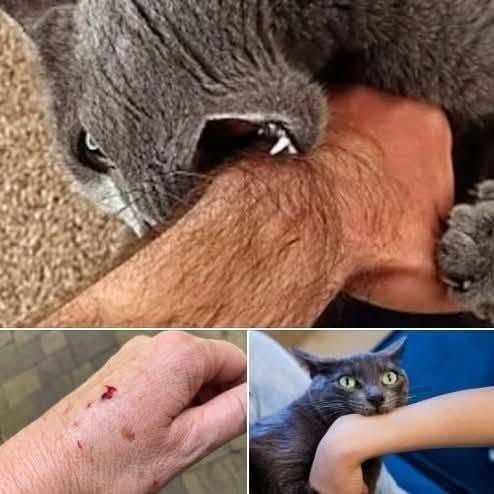
If someone says “If the cat bites you, here’s what it really means,” here’s a more detailed explanation of the different types of bites and what they typically communicate:
1. “I’ve had enough.” (Overstimulation)
This is one of the most common reasons for a bite. A cat may enjoy being petted at first, but after a while it becomes overwhelming.
Signs before the bite:
- Tail starts twitching or swishing.
- Ears turn sideways or flatten.
- Skin ripples along the back.
- Pupils become larger.
- The cat suddenly turns its head toward your hand.
What to do: Stop petting when you notice these signals and give the cat some space.
2. Play Biting
Young cats and kittens often bite during play because they’re practicing hunting behaviors.
Characteristics:
- Usually gentle and accompanied by pouncing or chasing.
- The cat isn’t angry or hissing.
- Often happens while playing with hands or feet.
What to do: Use toys instead of your hands so the cat learns that hands aren’t playthings.
3. Fear or Self-Defense
A frightened cat may bite because it feels trapped or threatened.
Signs:
- Hissing or growling.
- Flattened ears.
- Arched back or crouched posture.
- Puffed-up tail.
What to do: Don’t corner the cat. Give it an escape route and allow it to calm down.
4. Pain or Illness
A normally friendly cat that suddenly bites may be experiencing pain.
Possible clues:
- Biting when touched in one specific area.
- Limping or reluctance to move.
- Changes in eating, grooming, or behavior.
What to do: If the behavior is new or unusual, a veterinary examination is a good idea.
5. Affection Bites (“Love Bites”)
Some cats gently nibble the people they trust.
Characteristics:
- Very light pressure.
- Doesn’t usually break the skin.
- Often happens while purring or grooming you.
These bites are generally a form of social bonding rather than aggression.
6. Territorial or Protective Bites
Cats may bite to defend:
- Their territory.
- Food or favorite toys.
- Their kittens.
- Themselves from unfamiliar people or animals.
7. Redirected Aggression
Sometimes a cat becomes highly aroused by something else—such as another cat outside a window—and bites the nearest person.
What to do: Don’t try to handle the cat immediately. Wait until it has calmed down.
Is a Cat Bite Dangerous?
Even a small puncture wound can become infected because a cat’s sharp teeth can push bacteria deep beneath the skin.
Seek medical care promptly if:
- The bite breaks the skin.
- It’s on your hand, face, or near a joint.
- Redness, swelling, warmth, pus, or fever develops.
- You have diabetes, a weakened immune system, or poor circulation.
- The cat’s rabies vaccination status is unknown or the bite came from a stray or wild animal.
First Aid
- Wash the wound with soap and running water for 5–10 minutes.
- Allow it to bleed slightly unless bleeding is severe.
- Apply an antiseptic.
- Cover it with a clean bandage.
- Get medical advice as soon as possible if the skin was punctured.
Summary
A cat bite is a form of communication. It may mean:
- “Stop petting me.”
- “I’m playing.”
- “I’m scared.”
- “I’m in pain.”
- “I trust you.” (gentle love bite)
- “Stay away from my space.”
The context and the cat’s body language are the best clues to what the bite means. Regardless of the reason, any bite that punctures the skin should be cleaned promptly and evaluated for the risk of infection.