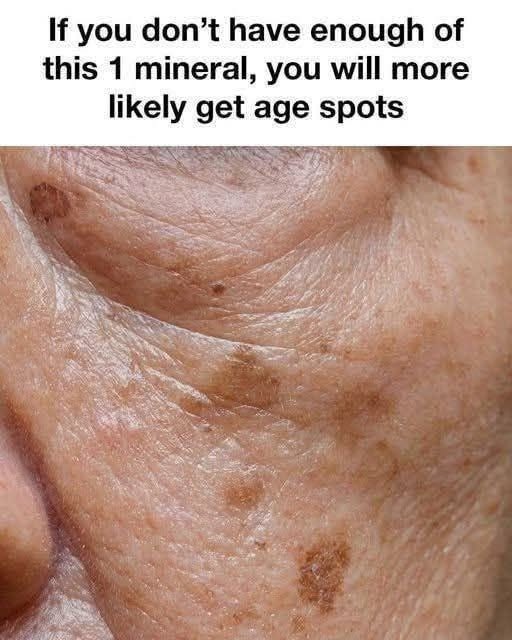
🌞 If You Don’t Have Enough of This 1 Mineral, Will You Be More Likely to Get Age Spots?
You may see headlines claiming that a deficiency in one specific mineral causes age spots. There is no strong scientific evidence that a lack of any single mineral directly causes age spots.
Age spots (also called solar lentigines or sun spots) are primarily caused by years of exposure to ultraviolet (UV) radiation from the sun or tanning beds.
🌞 What Are Age Spots?
Age spots are:
- Flat brown, tan, or black patches
- Usually painless
- Common on the:
- Face
- Hands
- Shoulders
- Forearms
They become more common with age because of cumulative sun exposure.
What Causes Them?
The main factors include:
☀️ Sun exposure – The biggest risk factor, as UV light stimulates excess melanin (skin pigment).
👵 Aging – Skin changes over time make age spots more common.
🧬 Genetics – Some people are naturally more prone to developing them.
What About Minerals?
Several minerals are important for healthy skin, including:
🥜 Zinc
Zinc helps with:
- Skin repair
- Wound healing
- Immune function
A zinc deficiency can cause skin problems, but it has not been shown to directly cause age spots.
🥬 Selenium
Selenium is involved in the body’s antioxidant defenses.
While it supports overall health, there is no good evidence that low selenium alone leads to age spots.
🥬 Copper
Copper plays a role in melanin production, but deficiencies are uncommon, and there is no clear evidence that low copper causes age spots.
How to Help Prevent Age Spots
The most effective steps are:
✅ Wear a broad-spectrum sunscreen (SPF 30 or higher) every day on exposed skin.
✅ Reapply sunscreen every two hours when outdoors, or after swimming or sweating.
✅ Wear a wide-brimmed hat and protective clothing.
✅ Seek shade during peak sunlight hours (typically 10 a.m. to 4 p.m.).
✅ Avoid tanning beds.
Can Age Spots Be Treated?
If you want to reduce their appearance, options include:
- Topical retinoids
- Vitamin C serums
- Chemical peels
- Laser treatments
- Cryotherapy (for some spots)
These treatments should be discussed with a dermatologist to determine what’s appropriate for your skin.
When to Have a Spot Checked
See a healthcare professional if a spot:
- Changes rapidly in size
- Has irregular borders
- Becomes very dark or has multiple colors
- Bleeds, itches, or doesn’t heal
Not every dark spot is an age spot, so unusual changes should be evaluated.
The Bottom Line 🌿
No single mineral deficiency has been proven to cause age spots. The strongest, well-established cause is long-term sun exposure. A balanced diet supports healthy skin, but the best way to help prevent age spots is to protect your skin from UV radiation and have any unusual skin changes evaluated promptly.