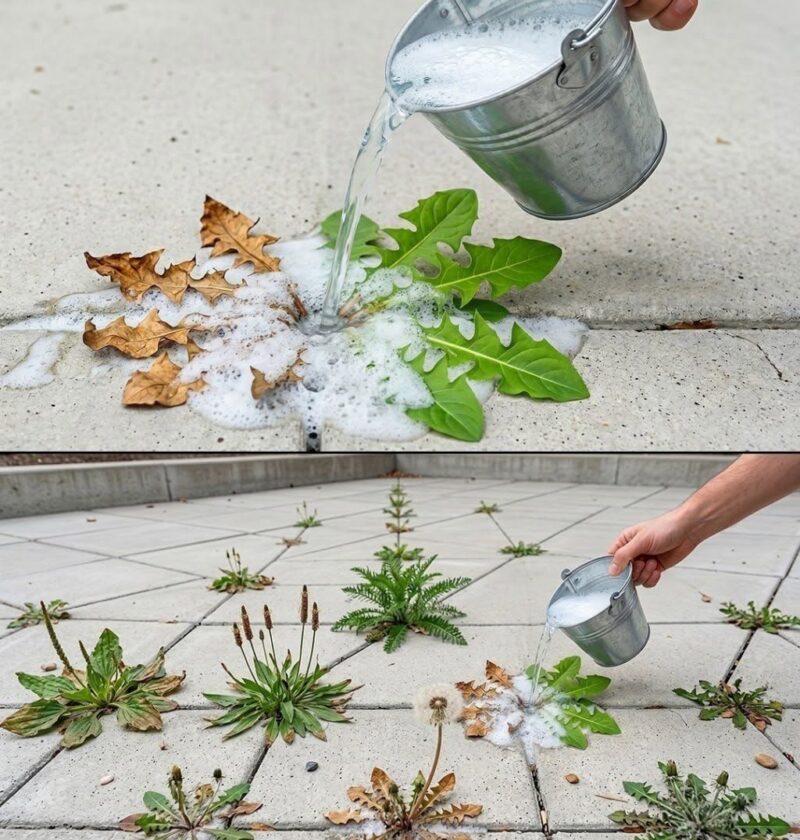
“THIS Burns Weeds in 1 Day! They NEVER Grow Again” — Detailed Explanation
Many online videos and articles claim that a certain homemade spray or household ingredient can burn weeds in one day and stop them from ever returning. While some methods can make weeds look dead very quickly, the claim that they “never grow again” is usually unrealistic.
To understand why, it helps to know how weeds survive and how different weed killers work.
Why weeds can be so difficult to eliminate
A weed is not just the green leaves you see above the ground. Many weeds have a hidden underground survival system.
1. Deep root systems
Some weeds grow extensive roots that store energy.
Examples:
- Dandelions have long taproots.
- Bindweed spreads through underground roots and rhizomes.
- Nutsedge produces underground tubers.
If only the leaves are damaged, the plant may use stored energy in the roots to grow again.
2. Weed seeds can survive for years
Many weeds produce thousands of seeds.
These seeds can:
- Remain dormant in soil.
- Sprout when conditions become favorable.
- Be carried by wind, birds, animals, or rain.
Even if you remove every visible weed today, new weeds can appear later.
Fast weed-burning methods
1. Vinegar weed spray
A common homemade weed killer uses vinegar because the acid damages plant cells.
How it works:
- The acid removes moisture from leaves.
- Plant tissue becomes damaged.
- Leaves turn brown and appear burned.
Best for:
- Small young weeds.
- Sidewalk cracks.
- Driveways.
- Areas without desirable plants.
Limitations:
- Regular kitchen vinegar is often too weak for tough weeds.
- It usually does not kill deep roots.
- Perennial weeds may return.
2. Boiling water
Boiling water is one of the fastest non-chemical methods.
How it works:
The extreme heat:
- Bursts plant cells.
- Damages leaves and stems.
- Can kill shallow-rooted weeds.
Best uses:
- Between paving stones.
- Along sidewalks.
- Around patios.
Problems:
- It can burn nearby grass and flowers.
- Deep-rooted weeds may survive.
3. Salt-based weed killers
Salt has been used historically to prevent plant growth.
How it works:
Salt:
- Pulls water away from plant cells.
- Disrupts the plant’s ability to absorb moisture.
Why it is risky:
Salt can remain in soil and:
- Prevent grass and flowers from growing.
- Damage trees and shrubs.
- Harm soil quality.
Salt is usually not recommended for garden areas.
4. Commercial weed killers
Some herbicides work by:
Contact action
They destroy the parts of the plant they touch.
Advantages:
- Very fast visible results.
Disadvantages:
- Roots may survive.
Systemic action
They move through the plant.
Advantages:
- Can kill roots and underground structures.
- Better for perennial weeds.
Disadvantages:
- Often take longer to show results.
Why “one-day miracle weed killers” seem to work
Many videos show weeds turning brown quickly. This can happen because the product damages the leaves.
However:
Brown leaves ≠ dead plant.
A weed may appear destroyed but still have:
- Healthy roots.
- Underground stems.
- Stored energy.
Weeks later, new growth may appear.
The best way to stop weeds long-term
Step 1: Remove existing weeds
For small areas:
- Pull weeds when the soil is moist.
- Remove as much root as possible.
For stubborn weeds:
- Dig deeper.
- Remove underground runners.
Step 2: Prevent new growth
Use mulch
A thick mulch layer blocks sunlight.
Good options:
- Wood chips.
- Bark mulch.
- Straw.
- Compost.
Improve lawn health
A thick, healthy lawn naturally prevents weeds by:
- Blocking sunlight.
- Competing for water and nutrients.
Seal cracks
For driveways and paths:
- Repair cracks.
- Use appropriate fillers.
- Prevent soil buildup where seeds can grow.
Natural weed control recipe ideas (with caution)
A common homemade spray may contain:
- Vinegar
- A small amount of dish soap (helps the liquid stick)
The soap does not kill weeds by itself; it helps the solution stay on the leaves.
Use caution:
- Avoid spraying on grass, flowers, vegetables, or shrubs.
- Spray on calm days to prevent drift.
- Protect your skin and eyes.
When weeds need a different approach
Some weeds require special treatment:
Dandelions
Best controlled by:
- Removing the entire taproot.
- Using a targeted root-killing method.
Creeping weeds (bindweed, ground ivy)
Need:
- Repeated treatment.
- Root control.
- Long-term management.
Grass growing in flower beds
Requires:
- Careful removal or selective treatment to avoid harming desired plants.
Final conclusion
A spray that burns weeds in one day may exist, but a product that makes weeds “never grow again” does not realistically exist for normal garden conditions.
The fastest visible results usually come from:
- Vinegar-based sprays.
- Boiling water.
- Contact herbicides.
The longest-lasting results come from combining:
- Root removal,
- Prevention,
- Mulching,
- Regular maintenance.
The goal is not only to kill today’s weeds—it is to stop tomorrow’s weeds from getting established.