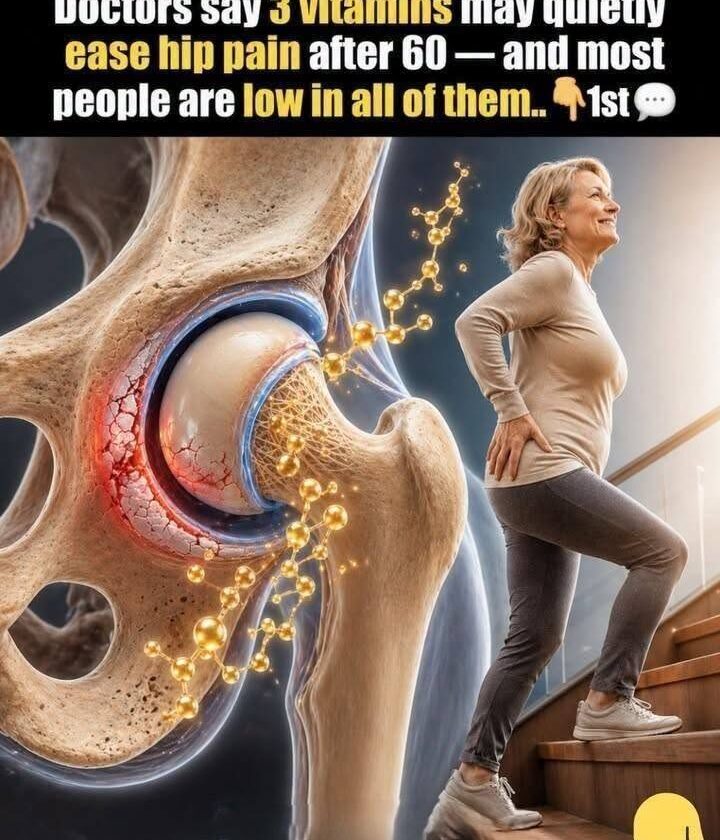
“Most Hip Arthritis Medication Treats the Signal, Not the Cause — But a Doctor Says 3 Vitamins May Reach What Most Painkillers Never Do” — What’s the Evidence?
This type of headline combines a true idea with a claim that needs careful interpretation.
It is true that many common hip arthritis treatments mainly focus on reducing symptoms, such as pain and inflammation. However, the idea that three vitamins can reverse hip arthritis or reach the root cause in a way painkillers cannot is not supported by strong scientific evidence.
Understanding hip arthritis
The most common type of hip arthritis is osteoarthritis (OA).
In hip osteoarthritis:
- The protective cartilage covering the ends of bones gradually wears down.
- The joint may become stiff and painful.
- Bone changes and inflammation can develop around the joint.
- Movement can become more difficult over time.
The damage is not simply a “pain signal problem.” Pain comes from a combination of:
- Joint tissue changes
- Inflammation
- Pressure on surrounding structures
- Changes in the nervous system’s response to pain
Why pain medications are called “treating the signal”
Many pain treatments reduce symptoms rather than rebuilding cartilage.
Examples:
NSAIDs (anti-inflammatory medicines)
These can:
- Reduce inflammation.
- Decrease pain.
- Improve mobility.
But they generally do not:
- Restore lost cartilage.
- Reverse arthritis damage.
Pain relievers
Some medications reduce the perception of pain but do not repair the joint structure.
That does not mean they are ineffective—they can be important tools for improving quality of life.
What about vitamins?
Certain vitamins and nutrients are important for joint and bone health, especially if someone is deficient.
1. Vitamin D
Vitamin D helps:
- Maintain bone strength.
- Regulate calcium absorption.
- Support muscle function.
Low vitamin D levels are associated with:
- Greater risk of bone problems.
- Muscle weakness.
- Sometimes increased pain sensitivity.
However:
- Taking extra vitamin D does not reliably reverse osteoarthritis if levels are already adequate.
2. Vitamin C
Vitamin C is involved in:
- Collagen production.
- Tissue repair.
- Antioxidant protection.
Because cartilage contains collagen, researchers have studied vitamin C and joint health.
However:
- There is no strong proof that vitamin C supplements rebuild worn hip cartilage.
3. Vitamin K
Vitamin K plays a role in:
- Bone metabolism.
- Calcium regulation.
Some studies have explored links between vitamin K status and joint health, but evidence is not strong enough to say it can treat hip arthritis.
Other nutrients sometimes discussed
Some supplements have more research behind them than vitamins alone:
Omega-3 fatty acids
Found in fish oil and some foods.
May:
- Reduce inflammatory activity.
- Help some inflammatory joint conditions.
Evidence for osteoarthritis pain relief is mixed.
Glucosamine and chondroitin
Popular joint supplements.
Research results are inconsistent:
- Some people report benefit.
- Others see little or no improvement.
What actually helps hip osteoarthritis?
Treatments with stronger evidence include:
1. Exercise and strengthening
Often one of the most effective approaches.
Helpful activities:
- Walking programs.
- Swimming.
- Cycling.
- Hip-strengthening exercises.
- Physical therapy.
Exercise can:
- Improve joint stability.
- Reduce pain.
- Improve function.
2. Weight management (if applicable)
Reducing excess body weight can decrease stress on the hip joint and may improve symptoms.
3. Physical therapy
A therapist can help improve:
- Hip mobility.
- Muscle strength.
- Movement patterns.
4. Medical treatments
Depending on severity:
- Anti-inflammatory medications.
- Injections.
- Assistive devices.
- Hip replacement surgery for advanced disease.
When to be cautious about supplement claims
Be careful with products claiming:
- “Regrow cartilage.”
- “Reverse arthritis.”
- “Repair joints naturally.”
- “Doctors don’t want you to know this.”
Cartilage repair in an already damaged arthritic hip is a complex medical challenge, and no vitamin has been proven to accomplish this.
Bottom line
Vitamins such as vitamin D, vitamin C, and vitamin K are important for overall bone and tissue health, and correcting a deficiency may improve health and sometimes symptoms. However, there is no strong evidence that these vitamins can reverse hip arthritis or replace proven treatments.
The most effective approach usually combines:
- Appropriate medical care,
- Regular joint-friendly exercise,
- Muscle strengthening,
- Healthy nutrition,
- Weight management when needed,
- Managing pain safely.